 Reddy2Help
Students should decide what AI should not do
AI education is stronger when students learn to choose which parts of a task belong to a person and which parts a tool can support.
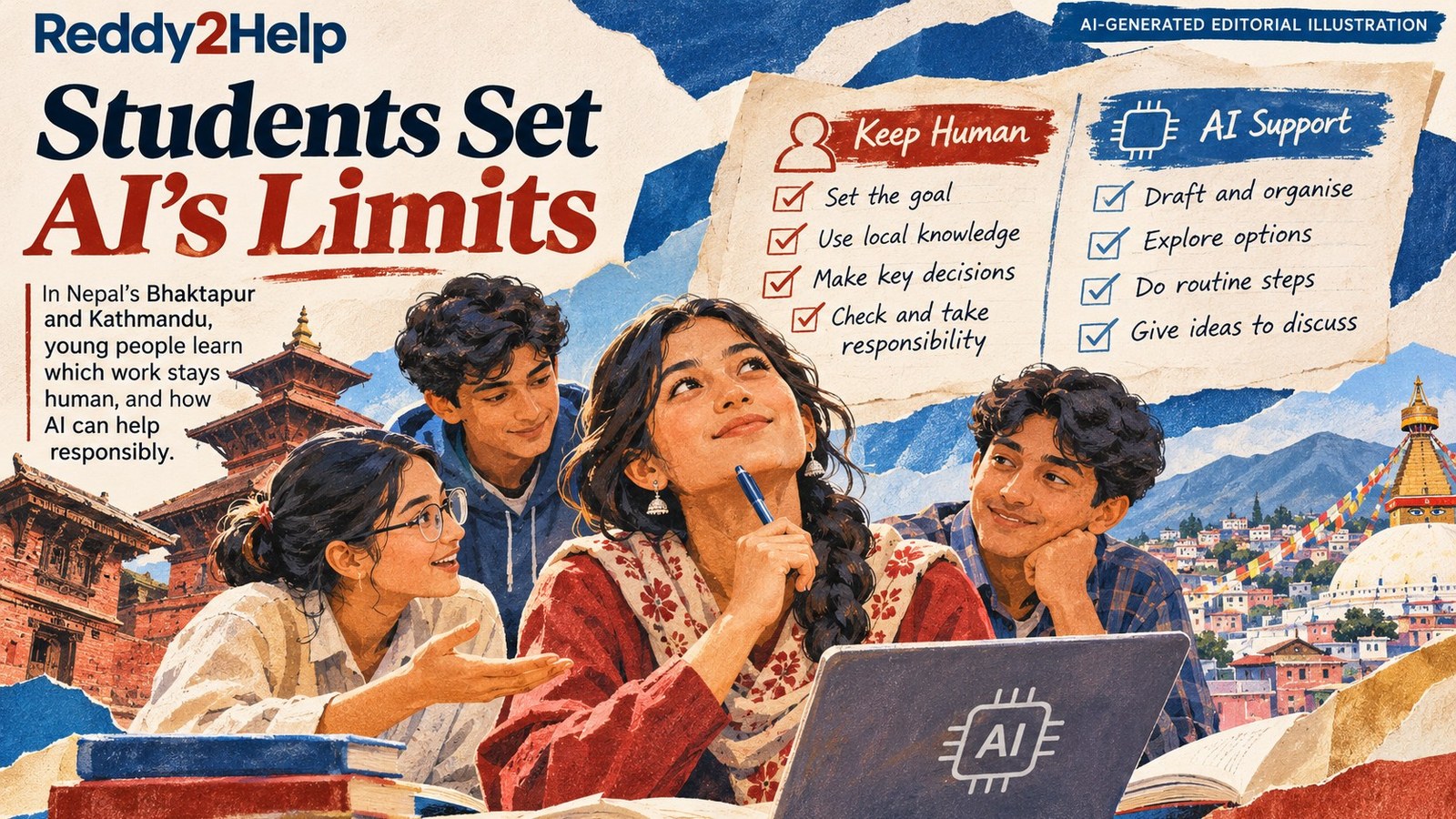
The missing decision
AI lessons often begin with a request: ask the tool to write, draw, explain or organize something. That is useful practice, but it can make the tool seem like the center of every task. A more important question comes first: which part of this work should remain with a person?
At the Asha school, this is a practical question rather than a philosophical one. Students are learning how technology can help with limited resources, so they also need to notice when using a tool would remove something valuable: a local judgment, a personal explanation or a conversation with someone who knows the situation. This is part of AI education, not a separate lesson after it.

A task is more than its output
Two pieces of work can look similar and still require different choices. A student might use AI to suggest headings for a noticeboard, then decide the words that neighbors will actually understand. The suggestion is support. The responsibility for meaning remains with the student.
That distinction gives students a way to examine a task before opening an app. They can ask:
- What am I trying to help someone do?
- What do I know that the tool cannot know?
- What would be lost if a person did not make this decision?
- Which part can I check by looking, asking or testing?
These questions do not reject AI. They make its role smaller and clearer, which is often what makes the tool more useful. That practice is student judgment in action.
The human part is not a leftover
Students can be encouraged to divide a project into three parts: work a tool can assist with, work a person must decide, and work that needs another person’s response. The divisions will change with the project. A draft explanation may be easy to improve with AI, while deciding whether the explanation is respectful requires attention to the audience.
This matters especially when a task involves people who are not in the room. A generated sentence can sound smooth and still use the wrong level of detail or the wrong kind of example. A student who has to choose what belongs in the final version is practicing judgment, not merely editing a machine’s answer. That is responsible AI use because the student remains accountable for the result.

A small project can show the difference
A teacher does not need an elaborate assignment to teach this skill. Students can take one ordinary communication task and mark each step before they begin. They might plan a short explanation, create a rough version, ask someone to read it, and revise it after hearing what was unclear.
The useful lesson is not that AI produced a draft. It is that the student decided where the draft could help and where another person’s response mattered more. The final work should make that decision visible through its clarity, audience and purpose.
A simple review can ask students to identify:
- the decision they kept for themselves
- the part where AI saved time or offered alternatives
- the point where another person changed the work
- the reason they accepted or rejected a suggestion
Choosing limits is a technology skill
There is pressure to treat more automation as better use of technology. For young people, the stronger skill may be knowing when not to automate. A student who can set a boundary is better prepared for new tools than one who has only learned a list of commands. This is human decision-making, and it is a technology skills lesson that can survive the next app.
This is also a way to make free tools serve people with fewer resources. When money, equipment and time are limited, a tool can help with a repetitive step. But it cannot replace the knowledge held by a family, a teacher or a neighborhood. Keeping that knowledge in the process prevents convenience from becoming carelessness.

Reddy2Help’s work is about putting useful technology within reach of young people. That means teaching access, but it also means teaching control. Students should leave an AI session able to say not only what a tool can do, but what they have chosen to keep human.
How can students learn when they should not use AI?
Students can learn by separating a project into tasks AI can assist with, decisions a person must make, and parts that require another person’s response. Reddy2Help can teach this judgment alongside practical AI skills so young people use free tools without surrendering responsibility or local knowledge.