 Reddy2Help
Students should check AI answers before they trust them
AI can help students begin research, but checking its claims against reachable sources is part of learning.
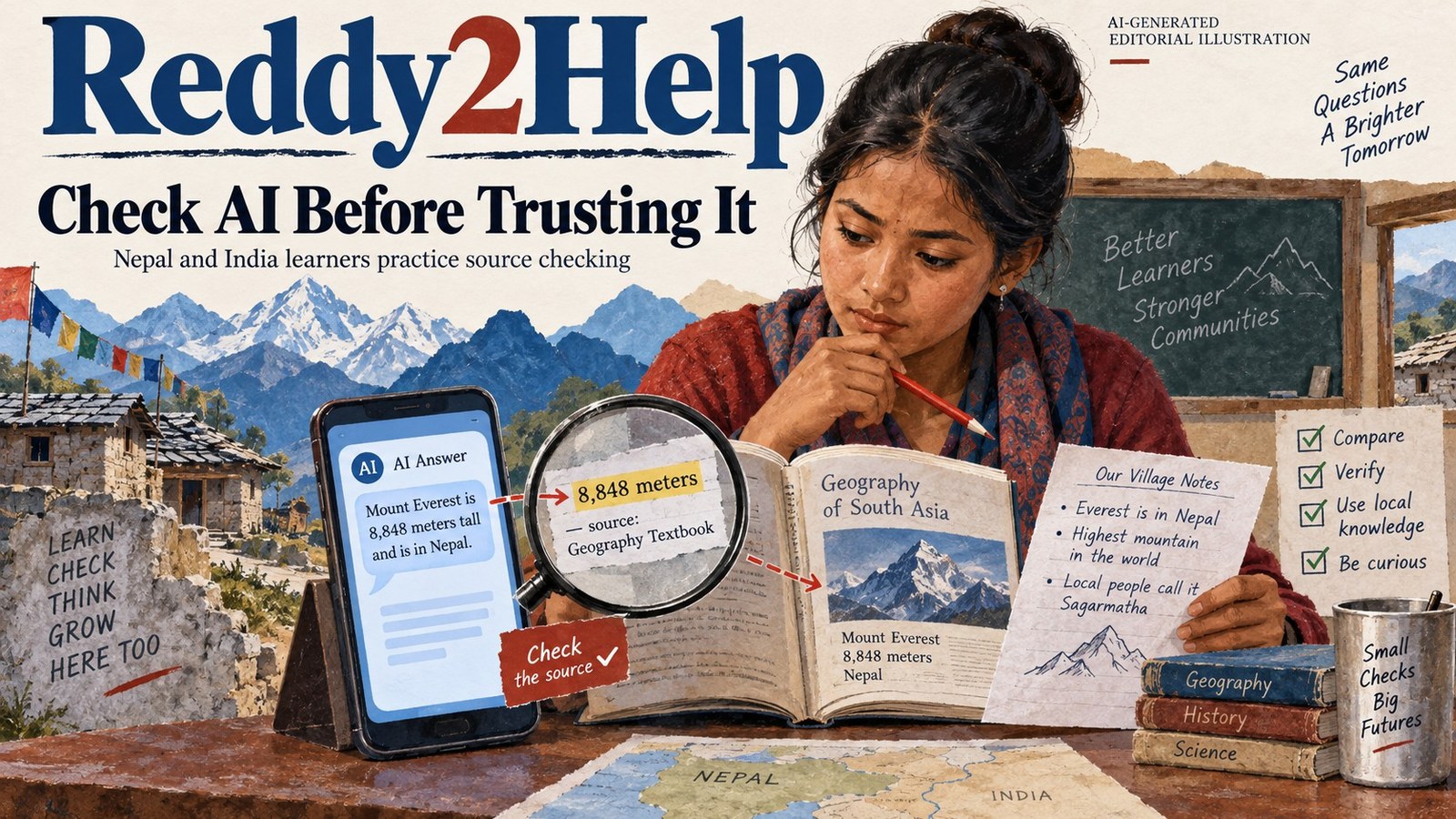
An answer is a starting point
An AI tool can produce a polished answer before a student has decided what the question means. That speed is useful, but it can hide the first piece of learning: deciding whether an answer deserves to be trusted.
For a student working with limited access to books, teachers or reliable internet, this matters even more. A confident sentence can travel quickly through a classroom or a phone. If it is wrong, the student may have no easy way to notice. The lesson should make checking part of the task, not an extra warning at the end.

What checking looks like
Verification does not need a research library. A teacher can ask a student to take one sentence from an AI response and look for support in a textbook, a local reference book, a public notice or a trusted organization’s website. The point is not to prove every word at once. It is to practice breaking a large answer into claims that can be examined.
A useful classroom exercise starts with a question that has an answer students can investigate. They ask the AI tool, copy one claim onto paper, and mark what evidence would count. Then they compare the claim with a source and write down what changed. The final step is as important as the search: the student explains why the source was stronger, weaker or simply answering a different question.
- What exactly is the answer claiming?
- Which part can be checked?
- Who produced the source?
- Does the source show evidence for this claim?
Local knowledge belongs in the room
Students should not be taught that an online answer is automatically better than what people around them know. A shopkeeper may know how a road floods, a health worker may know which advice is safe to share, and a family member may remember how a neighborhood changed. Those accounts still need care, but they give students something concrete to compare with a machine’s response.
That comparison can reveal a problem that a generic lesson misses. An AI answer may use a familiar word in an unfamiliar way, assume a service exists, or describe a place as if every community had the same options. Asking students what the answer leaves out turns local experience into a question for investigation rather than treating it as an anecdote to ignore.

The teacher sets the boundary
A checking exercise can go wrong if students are asked to investigate claims that require specialist knowledge or expose a family’s private experience. The teacher has to choose the subject, the sources and the amount of detail that belongs in the room. A good prompt is narrow enough to check and ordinary enough that students can discuss it safely.
Teachers can also show that uncertainty is a proper result. If two sources disagree, the student does not have to force a winner. They can record the disagreement, identify what each source can support and decide what would be needed next. That is a more useful habit than treating every question as a race toward a single fluent answer.

A better use for the tool
AI becomes more useful when students use it to generate questions, possible explanations or terms to investigate, then do the checking themselves. The tool can help a learner see where to begin. It should not quietly become the authority that ends the lesson.
For a classroom with limited time, the routine can stay small:
- Ask for an answer in plain language.
- Choose one claim instead of accepting the whole response.
- Compare it with a source a student can actually reach.
- Revise the answer and explain the reason.
This takes judgment, not expensive equipment. It also gives students a skill they can carry beyond a lesson: pause when an answer sounds certain, find out who supports it, and notice what the answer does not say. That is how a free tool becomes part of learning rather than a shortcut around it.
How can students use AI without trusting every answer it gives?
Students can use AI to suggest questions or explanations, then check one claim against a source they can reach, such as a textbook, public notice or trusted organization. Reddy2Help treats that checking process as part of learning, not as an optional warning after the answer.