 Reddy2Help
AI lessons should teach students what not to share
Students need practical privacy habits so free AI tools can help them without turning personal information into a hidden cost.
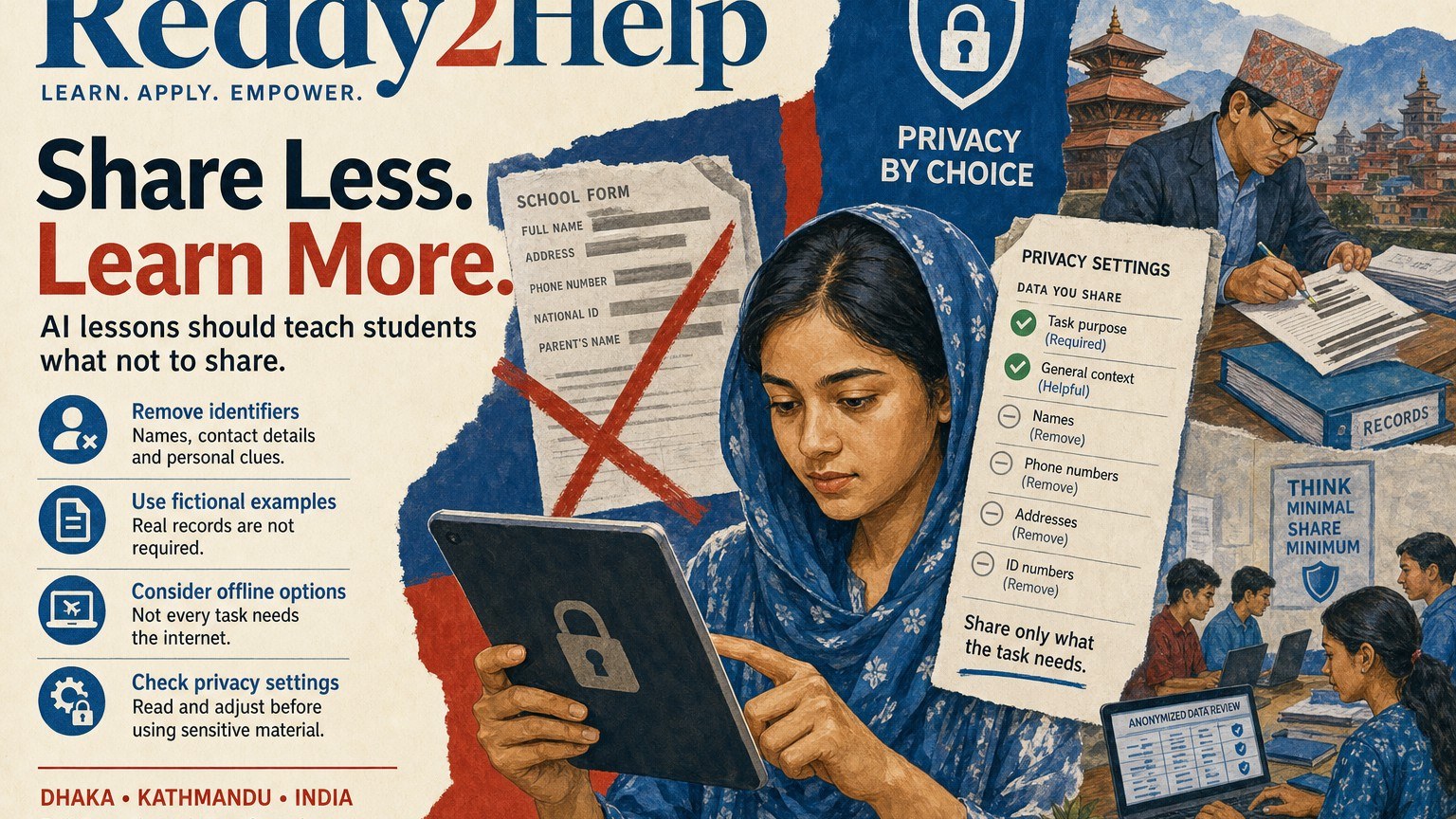
Free tools still have a cost
A free AI tool does not mean that every use of it is free of consequences. A student may paste a family message, a school form, or a customer’s phone number into a chatbot because the tool appears to be the quickest way to translate, summarize, or rewrite it. The answer may be useful, but the information has left the student’s control.
This is why privacy belongs in technology education, especially when learners are using borrowed devices and services they do not administer. AI privacy is not about avoiding every tool. It is about knowing which details a task actually needs, and which details can stay out of it.

Start with the smallest useful prompt
A student does not need to provide a person’s full name to ask for help improving a message. They can remove names, addresses, phone numbers, account details, and other clues that identify someone. They can describe the situation in general terms and add only the information needed for the tool to do its job.
That habit changes the question from “What can I paste?” to “What is the minimum this task requires?” For a translation, the words may be enough. For a spreadsheet formula, invented labels can replace real names. For a letter, a description of the audience may work better than the recipient’s personal history.
A useful checklist is simple:
- Remove names and direct contact details.
- Replace real records with fictional examples.
- Check whether the task can be completed offline.
- Read the tool’s privacy explanation and privacy settings before using sensitive material.
Consent is part of good work
Privacy is not only about a student’s own information. People who ask students for help may not know that an AI tool is involved. A translated message, a job application, or a small business record can contain someone else’s story. Using it without permission may solve one problem while creating another.
Students can practice asking for consent in plain language: what tool will be used, what information will be entered, and what will happen afterward. If permission is unclear, the safer choice is to remove identifying details or use a made-up example. This is a work habit, not a technical trick.

The same principle applies when students make projects for other people. A useful design should not require a person to surrender more information than the service needs. A form that asks for a phone number, location, and family details when it only needs a preferred appointment time is asking too much.
Privacy can be tested like any other skill
A class can test an AI project by trying to find information it should never have received. Students can inspect prompts, copied text, saved files, browser history, and shared links. They can ask whether another person could identify the subject from the remaining details, even after a name has been removed.
They can also compare two versions of the same task: one using real information and one using a fictional example. If the answer is just as useful, the real information was unnecessary. That comparison gives students evidence for a privacy decision instead of turning privacy into a warning they are expected to memorize.

The goal is not perfect secrecy. A student may still need to use a service, share a document, or ask for help. The goal is to make the choice visible, so convenience does not quietly become consent.
What Reddy2Help can teach
Reddy2Help’s technology and AI education can treat privacy as part of making useful work. A student who builds a translation guide, repairs a recordkeeping process, or prepares a customer message should be able to explain not only how the tool produced the result, but also why particular information was included or excluded.
That explanation is valuable beyond one chatbot. Tools change, accounts close, and new services appear. A student who understands data minimization, consent, and careful review can carry those habits to the next tool without waiting for a new set of buttons.
The strongest free tool is not automatically the right tool for every task. Sometimes the responsible answer is to use a fictional example, keep the work on the device, ask permission first, or do the task without AI. Knowing when not to share is part of knowing how to use technology well.
How can students use free AI tools without sharing too much personal information?
Students can use free AI tools more safely by removing names and identifying details, asking permission before entering someone else’s information, and checking whether a task can be completed with a fictional example or without AI. Reddy2Help teaches these privacy habits as part of practical technology education.