 Reddy2Help
Poverty pulls children out of school long before technology ever reaches them
Child labor in Nepal and similar countries is driven mainly by poverty, and technology skills are one of the few paths to income a poor family can access without capital or years of schooling.
Why children leave school
The International Labour Organization and UNICEF have documented child labor as one of the most persistent reasons children in South Asia leave school, and Nepal is no exception. The pattern is consistent across countries: a family needs income now, and a child’s labor is available now, while an education’s payoff is years away.
This is not a failure of will. It is a failure of timing. A family choosing between a child in a classroom and a child earning wages is choosing between a long-term bet and an immediate need, and the immediate need usually wins.
Where the pressure comes from
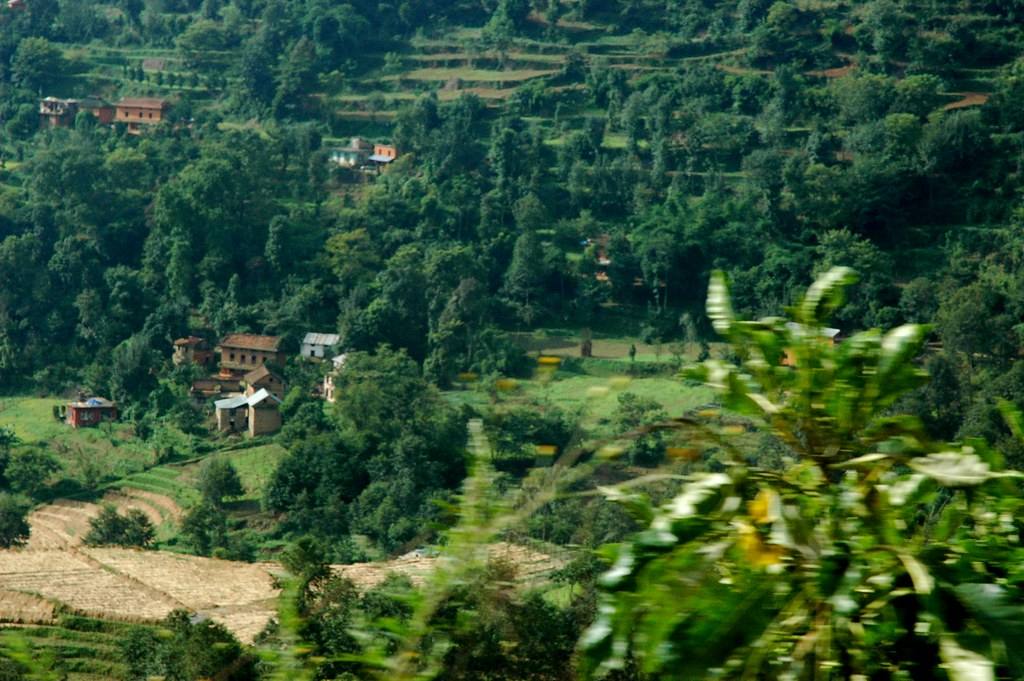
The work that pulls children away from school is rarely dramatic. It is ordinary and local.
- Agricultural labor during planting and harvest seasons
- Domestic work in another household
- Informal trade and street vending
- Family enterprises like small shops or workshops
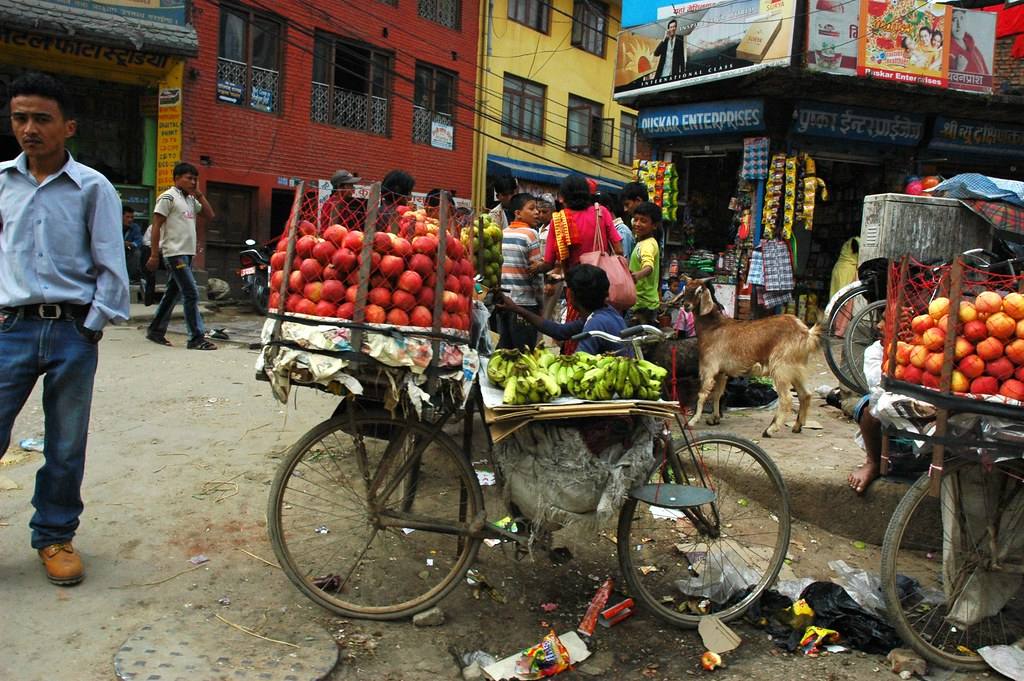
Each of these is work a family already understands, work that pays the same week it is done, and work that requires no equipment a poor household does not already own. On a Kathmandu street, bicycle carts piled with apples, bananas and oranges draw children and a goat past a shop while a man in a blue shirt walks on.
What the international response looks like
Governments and agencies have responded with school feeding programs, cash transfers tied to attendance, and stronger enforcement of minimum age laws. Nepal has ratified the relevant ILO conventions on minimum age and the worst forms of child labor, and its government runs programs aimed at bringing working children back into classrooms.
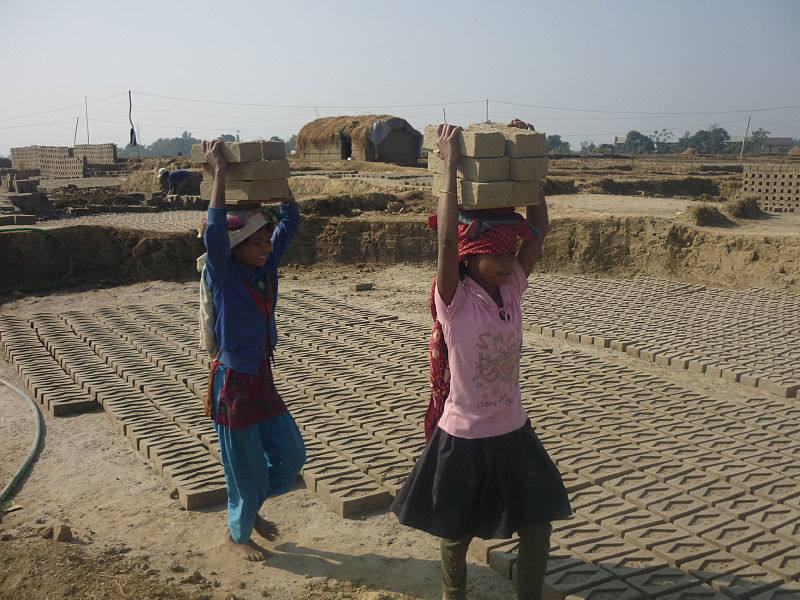
These programs treat the income problem directly: they try to make school attendance pay, or at least stop costing a family money it does not have. That is the right target, because the underlying driver is economic, not educational. In 2014, two barefoot girls carry stacks of bricks on their heads across a sunbaked kiln yard lined with rows of drying bricks.
Where technology skills fit
Reddy2Help’s programs sit next to this problem rather than inside it. Teaching a young person to use free AI and software tools does not replace a cash transfer or a feeding program, and it will not by itself end child labor.
What it can do is change what is possible once a young person has some schooling time. A free tool that runs on a borrowed laptop lets someone do design, writing, or basic coding work that used to require capital and years of training. That is a path to income that does not ask a poor family to wait as long as a traditional career does.
This matters because the choice families are making is often exactly this: wait years for a return, or earn now. Technology skills shorten that wait for some kinds of work, without pretending to shorten it for all of them.
What this does not solve
It would be dishonest to claim more than that. A student who has already left school for full-time work will not learn to use these tools in a classroom, because they are not in one. Technology education reaches the young people still attending, or attending part-time, and gives them another reason the classroom is worth the hours it costs a family.
It also does not replace the enforcement, the cash transfers, or the feeding programs that address child labor directly. Those remain the tools built for the problem. This is a second lever, not a substitute for the first one, and it works only where a young person has some access to school time in the first place.
The honest claim is narrower and still real: for a student who is in a classroom, even part of the week, a free tool and a first question to ask can turn that limited time into a skill a family can see the value of quickly. That is the gap Reddy2Help’s sessions are built to close.
Why do children in countries like Nepal leave school to work, and can technology change that?
Poverty, not lack of interest in school, is the main reason children leave school to work in Nepal and similar countries, according to the International Labour Organization and UNICEF. Reddy2Help’s technology and AI education gives students still in school a faster path to income-generating skills, but it does not replace the cash transfers, feeding programs, and enforcement that directly address child labor.